Archive for November, 2026

movies

Capers for Kids

Last weekend, I indulged in some nostalgia and watched Candleshoe, a 1970s Disney kids’ movie. I saw it at the theater when I was a kid but I didn’t remember much of it except, oddly, the final scene, for which I had the dialogue memorized.

This is a fun caper movie with an overpowered cast. A conman finds a tough street kid (Jodie Foster) who fits the description of a missing British heiress. He’s heard of a legend of hidden treasure at the Candleshoe estate, and he has the first clue. He needs someone on the inside to follow that clue and find the rest of the clues, and the treasure. She demands a cut if she’s going to go in on this, and then he and his cousin, who used to work in the house, coach her on how to act like the missing heiress. The lady of the manor (Helen Hayes) is skeptical that this could be her long-lost granddaughter, but our heroine wins her over. Then she learns that this lady has taken in kids from the local children’s home but is unaware of how precarious her situation is, with money needed for taxes and upkeep on the estate. Her loyal butler (David Niven) is trying to solve the problem, and he dresses up like various staff members to hide the fact that they’ve had to let everyone else go. The longer she stays, the more the imposter comes to like them all, and she wants to find the treasure to save the estate. But the bad guys are still out there.

This one is definitely aimed at kids, with a lot of slapstick humor and some over-the-top silliness, but there’s a really interesting story inside all that, with the cast delivering on the emotions. Jodie Foster was still very much “child actor,” but she’s so genuine and subtle that it’s no surprise she grew up to be an Oscar winner. David Niven and Helen Hayes are having way too much fun.

I remember that when I was a kid, this played into all those “I’ll find out I’m a long-lost princess” type fantasies, and I know that I was excited to see the movie as soon as I heard about it. As an adult, I found myself wondering how they could have done this story by taking it a little more seriously. Most of it works, but the final confrontation with the bad guys gets a bit silly. It’s beautifully choreographed and very clever, but it’s also rather ridiculous and not always well executed — there are a lot of punches that obviously don’t land but that send the recipient flying. I imagine that the silliness was what was needed to get a family-friendly rating back then. That takes the edge off the violence, and when you think about it, the violence is aimed at children, so it’s pretty horrifying.

Now I find myself pondering how much fun it might be to write a caper story along these lines, with someone pretending to be a long-lost heiress in order to find/get something, and with a hint of ambiguity about whether she might be the real thing.

I’m taking all of next week off for the Thanksgiving holiday, so see you in December!
Books

Art Based on Life

I got to my latest read through an odd rabbit trail that spanned a few years. I’m not sure where I first heard about the Mitford sisters. I think they came up through something else I was reading when I was in a “between the wars” phase a few years ago and reading about life in the 20s and 30s. They were sort of the Kardashians of England in that era, daughters of a minor nobleman who ran with the “bright young things” crowd of London in the 30s. Their father thought educating girls was a waste, so they weren’t sent to school. They had a few years with governesses and went to finishing school but otherwise were mostly self educated by reading the books in their home library. And yet most of them ended up writing books and two of them were professional authors and journalists. The family was also pretty notorious for their politics. One sister left her husband to become the mistress (and later wife, after his wife died) of the founder of the British Union of Fascists. Another was such a Hitler fangirl that she got her father to send her to Munich to practice German, then basically stalked Hitler until she intrigued him enough that he asked to be introduced to her and she became part of his social circle, eventually introducing most of the rest of the family to him. Then there was the sister who became a communist and ran away to be part of the civil war in Spain.

The oldest sister, Nancy, became a novelist, writing satirical novels that were quite transparently based on her own family. I’d seen TV productions of The Pursuit of Love and Love in a Cold Climate before I knew anything about the author, and they were close enough to reality that when I was reading a book on the family I got a strange sense of deja vu and wondered why these events seemed so familiar. Now I’ve finally read the novels themselves.

The books have an interesting structure for a series in that they actually take place around the same time rather than the second book being a true sequel. Our narrator isn’t the main character of either book. She’s mostly an observer of her wacky relatives, so the second book covers another part of her family during the events of the first book where she’s not present and is relating things that she later heard about. The first book covers her mother’s relatives, a large family she spends holidays with. The cousin she’s closest to wants desperately to be in love and makes some pretty big leaps along the way as she tries to find it, including an early, ill-fated marriage and running away with an idealistic young communist. The second book is about some relatives on the narrator’s father’s side, a family with a beautiful daughter who’s sure to be a hit on the society marriage market because of her great beauty, but she’s cool and aloof and doesn’t seem to have any interest in any of the men she meets. But there’s a reason: She’s been in love since childhood with someone unavailable and unsuitable, and when he becomes available it throws the family into turmoil.

Oddly, these books reminded me a lot of Jane Austen. It seems like the sort of thing Austen might have written if she’d been writing about the 1920s and 1930s. They cover the same sort of country gentry/minor aristocracy set and the same “it’s critical to find a husband” issues and have the same sometimes over-the-top satirical characterizations. I wonder if it’s coincidence or deliberate the our narrator sent off to stay with relatives is named Fanny, like the heroine of Mansfield Park. Both characters are kind of meek and mousy and dealing with their scandalous family, though with different outcomes, and the Fanny in these books isn’t penniless. The voice is very Austen-like. Of course, there’s subject matter that Austen wouldn’t have touched, but she was writing in the late 1700s and early 1800s. She might have been racier in the 1930s.

I feel like I also detected some influences for Downton Abbey. Nancy Mitford herself seems like a model for some of Edith’s storylines, as the daughter of a nobleman who ends up writing for a magazine. Then there’s a storyline of a family who has only a daughter, so the estate will be inherited by a distant relative they’ve never met, so they invite him to come stay at the manor with them (though this character is nothing like Matthew in Downton Abbey, and no one dies on the Titanic for him to become the heir).

There’s not a lot of story structure to these books, and I’d say my biggest complaint is that they sort of fizzle out at the end. The characters come to an end of that phase in their life and the books just stop. They seem to be going for a “slice of life” thing rather than having any kind of arc. It leaves a somewhat dissatisfying feeling, like the story’s incomplete. It’s worse with Love in a Cold Climate because that one ends on a big change, but we don’t get to see the change. There is a third book, but it takes place more than a decade later and focuses on the narrator character. My library system has it, so I’ll have to read it and see if it also lets us know what became of the other people.

If you like Jane Austen for her snarky voice and skewering of certain character types and wonder how she’d have written about the 20th century, these might be worth looking into. But learning anything about the Mitfords can set off some research rabbit trails, and there are a lot of related works. For instance, there’s a series of mysteries with Nancy Mitford as one of the amateur sleuths (written by someone connected to Downton Abbey, which confirms my suspicion that the writer was at least aware of Nancy Mitford), and there’s a historical novel about Nancy Mitford’s relationship with her fascist sister, based on the premise that Nancy figured out she might be feeding info to the Germans and was the one who turned her in so that she spent much of the war in custody.

Books

More Magical Chick Lit

I’ve found yet another of those books like what I was looking for when I came up with the idea for Enchanted, Inc. but it didn’t exist then. This one was Rewitched, by Lucy Jane Wood. Back in the day, I’d have called it fantasy chick lit. Now I guess they’re calling it fantasy rom-com, but the romance is fairly subtle and secondary to the fantasy plot. The publisher labeled it fantasy, and the US editor is the editor for the Song of Ice and Fire books (she’s also an Enchanted, Inc. fan), but the library stuck a “romance” sticker on it and is shelving it in mainstream fiction.

Our heroine is from a magical family and knows she has powers, but they haven’t been a big part of her life. Magic is handy for reheating tea, but she hasn’t put in a lot of study or training. She’s more concerned with the bookstore where she works. She feels like she’s been a big part of making it a success, but now it seems like the owner’s son, a real corporate type, is going to take it over when the owner steps back. In the middle of all this, our heroine gets a notice that on her 30th birthday she has to be examined by the magical authorities, and if she fails, she’ll have her powers taken away from her. She’s doomed, but there is a reprieve. She has until the end of the month to complete certain magical tasks, with the help of an unlikely tutor and a mysterious (but handsome) guardian, and if she succeeds she gets to keep her powers. But there appears to be someone who wants her to fail, and meanwhile she has to deal with crises at work brought on by the new management. If she doesn’t rise to the occasion, her whole life will fall apart.

This book really is the blend of “chick lit” elements like work, family issues, friends, and romance with fantasy elements that I wanted when I was dreaming up Enchanted, Inc., and I think my readers would probably like this one. It takes place in London in the fall, and there’s the bookstore, so there’s a cozy vibe. You’ll want to read it with a cup of tea handy. The plot has some fun twists and turns, with some characters who turn out to be something other than you expect them to be. The romance is subtle and gradual, more of a subplot, and it grows out of organic interactions.

It looks like the author has one other book with a similar tone (possibly set in the same “universe”) that I’ll have to keep an eye out for.

Life

Apple Overload

I may have been overly enthusiastic about the local apple crop this week. I went out yesterday to run some errands. I have to finish my Christmas shopping for my family before Thanksgiving, so there were some places I wanted to hit, and along the way was a produce stand that sells apples from the local orchards. I want to make some apple butter and I needed to pick up some apples.

It turns out that they sell apples specifically for that purpose. You can get a half bushel of seconds, the apples that aren’t pretty enough to sell on their own, for far less than it costs to buy supermarket apples. They helped me pick out a bag of the right kind of apples for my needs.

But it turns out that half a bushel is a LOT of apples, more than I need to make even a large batch of apple butter. What I think I’m going to do is make and freeze some apple pie filling. I do a pre-cooked filling, where you cook the apples on the stove before making the pie. That way, you don’t have to include thickener and you get a stronger apple flavor, and the apples shrink before they go in the pie crust, so you don’t get that gap between the filling and the top crust that you get when the apples cook in the pie. And the pie cooks a lot faster. You’re just cooking the crust, not the filling.

So I figure I’ll cook a bunch of pie filling and freeze it in amounts to make various sizes of pie. Then when I want apple pie, I can just thaw some filling, make a crust, and bake. That’ll be especially handy if I need to bring a dessert to something. I might make a batch where I dice the apples instead of slicing them, so I’ll have tart or turnover filling. Apples cook down a lot, so I may not have as many as I think I have.

And now I know where this produce stand is to come back next year. They’re closing for the year next week, but this looks to be my best apple source. The fact that the book fair (three barns full of books) is on the way and it’s near the good shopping district in this nearby city is a bonus.

It looks like this will be an apple butter weekend. I do the initial cooking in the pressure cooker, which speeds up the process, but cooking that down into a butter takes a lot of time, and I tend to get impatient, so the apple butter is watery. Last year I finally got it right, so I’ll have to do it again. The timing is perfect because I just used up my last jar from last year.

Life

Fall color

Although I saw some terrific fall color in all my exploring last week, some of the most vivid colors have been close to home.

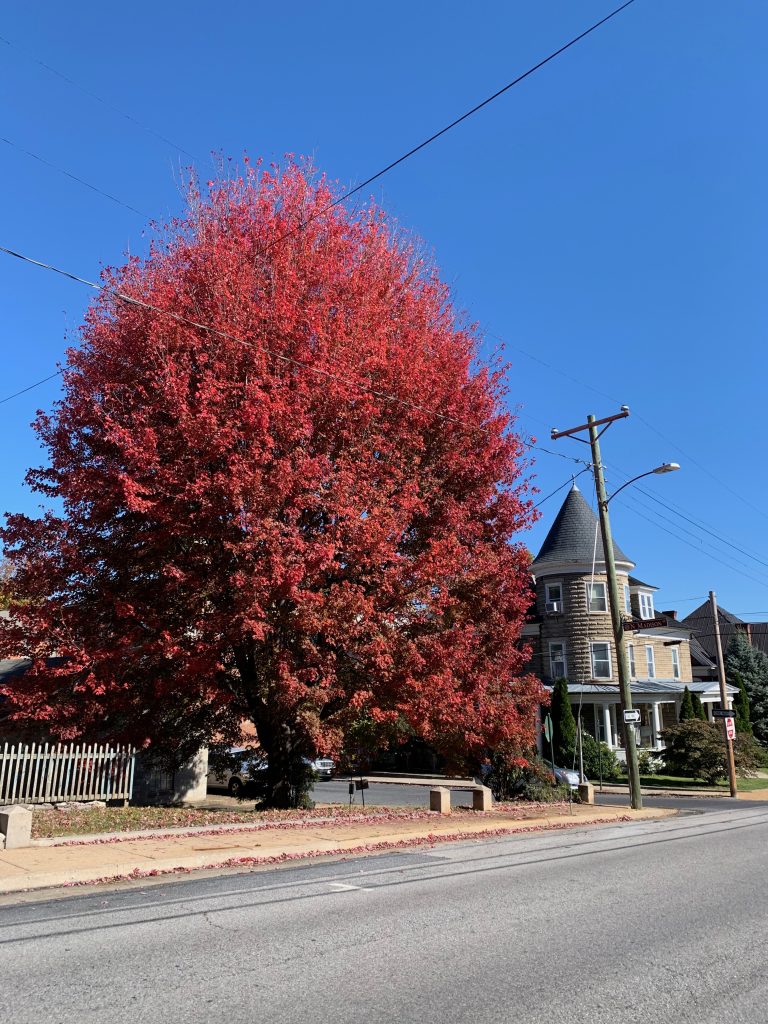
There’s this bright red tree I pass on my way downtown.

A bright red maple tree stands against a blue sky, with a Victorian house in the background.

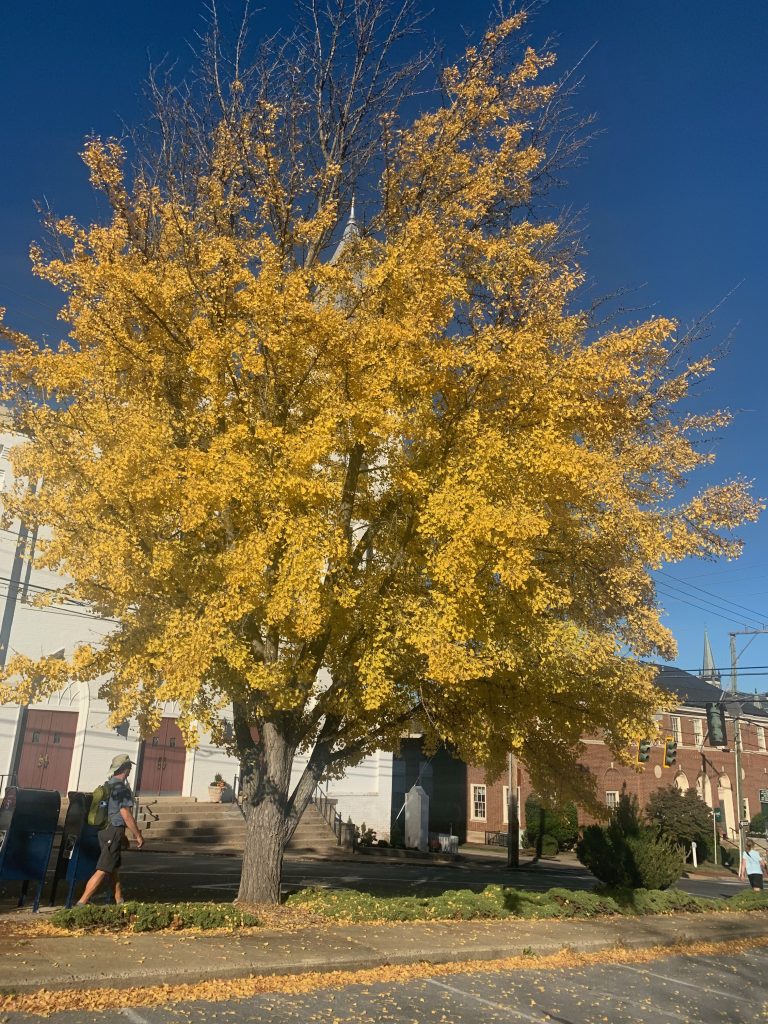
And the bright yellow ginkgo also downtown. It still had its leaves as of last night when I was coming home from choir practice.

A bright yellow ginkgo tree.

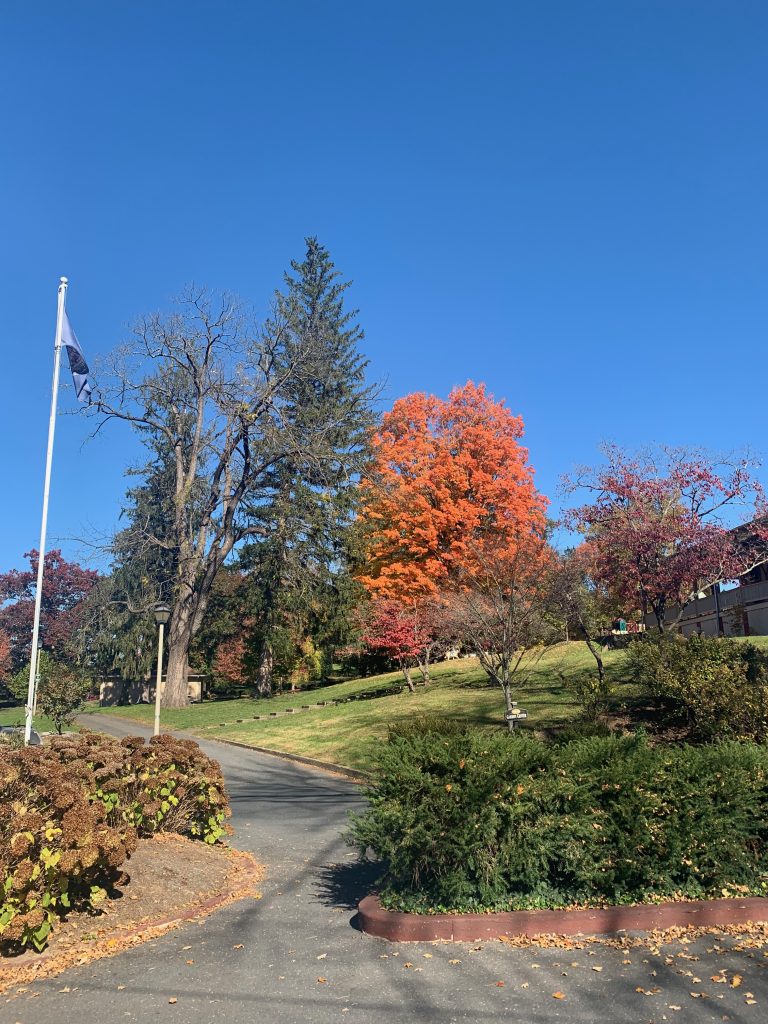
For orange, there’s this tree in the city park.

A bright orange tree is surrounded by evergreens in a park.

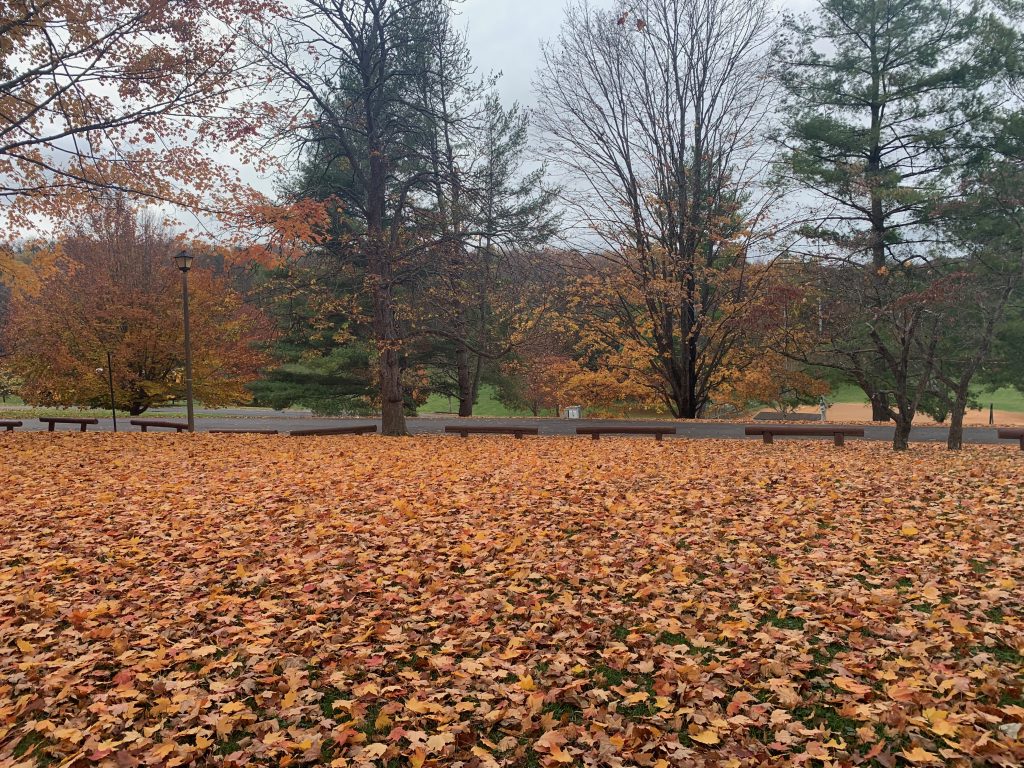
When I went out yesterday, a lot of the leaves had fallen at the city park near me where I go for hiking, but that made for a wonderful carpet of leaves.

A carpet of orange leaves covers the ground, with trees in the background.

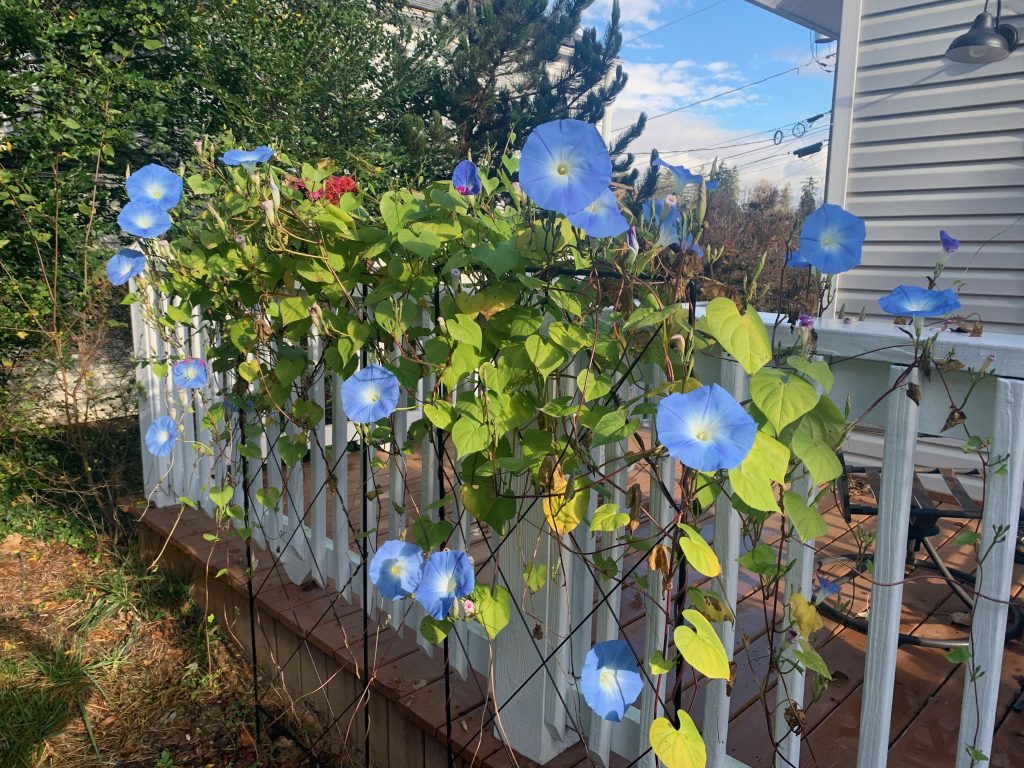
And as a contrast to the fall color, my morning glories have been going nuts this week, with some bright blues.

A mass of bright blue morning glory blooms covers trellises set against a white deck railing.

writing

The Revision Process

This week I’ve started revisions on book 6 in the Tales of Rydding Village series. I think I have an idea for a title, but I’m not sure yet. I’m looking at releasing sometime in February.

So far this week, I’ve gone through the book and made a reverse outline. That’s when I look at each scene and analyze what purpose it plays in the story. What happens, and why does it matter? What was the scene’s protagonist trying to accomplish and what was the outcome? Did anything changed? What in this scene leads to the next scene?

Looking at the book this way helps me see the character arcs and plot arcs by looking at the events and what they mean to the characters. I didn’t outline this book before writing it. I usually do a lot of outlining, but the opening scenes came to me while I was working on the outline, so I wrote them. Then more scenes kept coming to me, and I kept writing them, so I finished the book before I finished the outline. I was worried this would mean that I’d have to do a lot of rewriting, but this should be a pretty mild revision. The main thing I need to do is add something I came up with late in the book to the front of the book to properly set things up.

After doing this outline, I wrote a short synopsis of the story from each of the viewpoint characters’ perspectives, as well as a plot-level summary and the book’s sales blurb. That gave me a sense of how it should all flow overall.

Next, I’ll use this to make notes in my outline for what I need to fix from a plot level. I don’t think I’ll need to do any major restructuring. I don’t need to write new scenes, move scenes, or delete scenes, so I’ll probably do the plot and arc-level revision along with the scene revisions, where I make sure the scene structure works, add in any needed plot bits, and make sure the characters are having actual emotional responses (I’m bad about skipping that part). That’s all I’ll do on this draft. Then I’ll put it aside for a few weeks before I edit on the sentence/word level. That’s what I call the “making it pretty” pass, though I also do a lot of that during the first round of revision. I like to take another pass where I’m only looking at that, and I can also fix any errors introduced during the revision.