Archive for writing life

writing life

Feeding the Muses

I’ve been trying to use my time more productively, so even if I’m procrastinating, I’m still doing something worthwhile. As an alternative to clicking around on social media while I’m putting off doing something, I dug into my files and found a bunch of online courses I took about a decade ago. Some of them, I actually remember taking, but I’ve changed and my career has changed, so my answers to all the homework assignments are totally different. Some I don’t even remember taking. If I really don’t want to do whatever it is that I should be doing, at least I’m reading this material and doing the exercises, which is moderately helpful. It’s also been good this week since I’ve spent much of the week waiting on a plumber. I had an appointment on Wednesday, and when the appointment window passed with no word, I called, and they thought my appointment was Thursday (I’m almost certain it was Wednesday because I took the first open slot after the holiday). Then Thursday they called and said one of their trucks broke down, so could I reschedule for Friday. Now I’m waiting yet again. I can’t really focus on writing when I’m waiting, so doing these courses is a good way to spend the time.

Anyway, one of the courses was on finding and nourishing your “muses.” I’m not sure why I have these materials because I’ve never been that big into the “woo woo” side of writing. I haven’t named my muse, I don’t talk about “the girls in the basement” or anything like that, so I doubt I would have paid for this course. It must have been a bonus offering or something that came with a writing group membership. But the theme of the year is exploring, so why not?

The course encouraged us to really visualize our muses — the creative part of our subconscious — and then that will allow you to figure out how to feed and care for them so they can be even more creative and you can learn to listen to their input. I’ve never really thought of my creative side other than as The Voices (as in “the voices in my head said I should do this”), but I decided that if I have muses, they’re a group kind of like the Inklings, that group at Oxford that included C.S. Lewis and J.R.R. Tolkien. I imagine a group of professors hanging out in pubs and tea rooms, chatting about fantasy by the fire over cups of tea, or else they take long rambles around the countryside, making up stories as they go. Feeding these muses would involve going to libraries and bookstores, sitting by the fire with a cup of tea, or taking long walks.

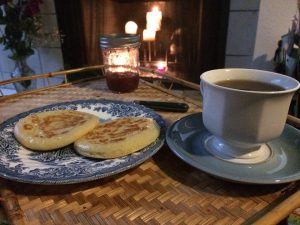
Since it was a cold, dreary day yesterday, I decided to take “feeding” literally and made crumpets and tea to have by the fireplace (my fireplace is filled with candles so I can get the warm glow without the hassle or mess). I don’t know if it sparked any creativity, but it was a fun break in the day and I still met my working time goal (the crumpets have to rise for about 45 minutes, which put a nice timer on a writing session).

crumpets and tea
Now I’ll have to make time for other things my professors might enjoy.

writing life

The Closet vs. the Book

I am tentatively planning the Epic Closet Purge this weekend. I need to do the seasonal closet changeover, anyway, as the old suitcase full of my winter clothes is currently sitting in the closet floor, where I’ve been pulling things out as needed. I need to pull the summer things out of the closet to make room for the winter things, and that makes it a good time to really evaluate the summer things as I take them out and the winter things as I put them away.

When I’m trying to clear out my closet, I have a bad habit of not wanting to get rid of anything. Either I’m still wearing things (whether or not I should) or I have sentimental attachments based on where I got things or where I’ve worn things. Sometimes it’s good when I stumble upon something I haven’t worn in ages and realize it makes a good outfit with something else, so it’s like shopping in my closet. But other times it means I’m hanging on to things I never wear. Then when it’s time to get dressed, I stare at a closet full of things I supposedly love too much to get rid of and wail, “I hate all my clothes and have nothing to wear!”

The “tentatively” part is because I’m really on a roll with this book I’m working on. I know what will happen several scenes ahead, and I’m having fun writing it. I want to be writing rather than having to force myself to write. When I’m supposed to be writing, I often have cleaning and organizing urges. I desperately want to purge and organize my closet. Now that I really need to purge and organize my closet, I desperately want to write.

So, I may not quite get to the full-on “take everything out and assess each item as to whether it sparks joy in you” purge. I may get rid of a few of the obvious things while I do a seasonal swap and then get back to writing. And then when I’m working on something else, maybe I’ll act on the “I must organize my closet” urge.

writing life

Morning Writing

I’ve always rolled my eyes at those “I get up at four and get all my words done before the day starts” writers. I’ve also rolled my eyes at the advice to get started on writing first thing in the morning, before you do anything else. I’ve never been much of a morning person. Even when my body clock started to shift last year, I wasn’t what real morning people would consider a morning person, and getting up earlier didn’t mean I started thinking earlier. I felt like I needed time to ease into the morning. I like to read the newspaper over breakfast and tea. Reading e-mail and various social media feeds was a way to warm up my brain and get going.

But I’ve been reading a number of things lately about getting started first thing in the morning with the most important thing you need to do, and I’ve seen testimonials from other writers about the difference it made to write first before doing anything else. I’ve been doing that somewhat over the last week, but I really dove in yesterday.

I still eased my way into the day somewhat, since I read the newspaper and ate breakfast, then took a walk. During the walk, I brainstormed a bit about the book I’m working on, imagining scenes and thinking about my characters. When I got home, I wrote down the things I’d thought about. Then I started writing. I managed to get half my target word count done before lunch, and I still managed to read my social media feeds and post a few things. I had time before lunch to practice some of my choir music. After lunch, I shut off the wi-fi again for another good writing session, and instead of the reflexive check e-mail, check the feeds break, I did a little tidying around the house. By the end of the day, I’d written more than 6,000 words, and I still had a little free time before the end of the work day.

The funny thing was, I don’t feel like I missed out on anything. I did more of what I wanted to do when I wasn’t wasting time doing mindless stuff. I don’t know how much of that has to do with writing early, but I think that helps with getting started. Starting is always the hardest part, breaking out of what I call the “doom loop” of reading the feeds, posting something, then going back to see if anyone’s responded or posted anything new. Once I’ve started, keeping going is easier, and starting before doing anything else does seem to help.

So, I’m sold. I guess I have a new work schedule.

writing life

Patio Office

It’s deadline week, So I’ll be digging in and focusing on my work. Not that it’s a do-or-die deadline. The final book is due in January. But I want to have time to revise it and also enjoy the holidays, so I’d like to finish this draft by the end of this week. I’m off to a good start. I got up early this morning and have already walked a couple of miles and written a couple of thousand words, along with planning out what I want to write today.

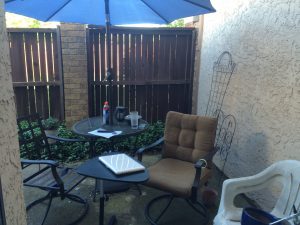
It’s a really nice day, so I’ve been enjoying Patio Office. That started when I thought I’d have a cup of tea on the patio after my walk while I did some brainstorming, then I decided to just haul the laptop outside and work. That way, I can enjoy fall and still get my words done.

Patio OfficeWhile I enjoy optimizing things, I also know that it’s good to shake things up every so often. Ruts are bad for creativity. I also like to take advantage of my flexible working conditions. I don’t have to sit in an office all day. Moving around keeps things fresh. I haven’t tried writing in public, though, since I’m easily distracted. I don’t think I’d get much done in a coffee shop, though I have gone to the coffee shop by the library to brainstorm and plot. I’ve gone to parks for brainstorming and plotting, too, especially when I need to be near water. Fortunately, I live near a lot of water, so it’s easy to find a place to sit by the water and think. Patio Office, taking my laptop desk onto my patio, is my way of getting away from the house to write. The wi-fi extends outside, but I don’t really think about going online when I’m outside, so I’m less likely to have the impulse. I can’t see any books I want to read or housework I need to do, so my only distractions come from nature, like watching the lizards sunning themselves, the snails creeping their way up the trellis, or the flowers blooming. And sometimes the mosquitoes that need swatting. My morning glory didn’t make it this year—between caterpillars and whiteflies, it got stripped of all its leaves—but my mum is blooming for the third year in a row.

It sure beats a desk in an office.

writing life

Flying Ideas

I totally forgot to post yesterday. I was so excited to get started writing and pleased with myself for being ahead of schedule — and then last night I realized that I was ahead of schedule because I skipped something. Oops.

But it was a really productive day. I wrote 5,000 words, planned today’s writing, and did some research reading for a future project.

Unfortunately, as tends to happen in this phase of a book, that research reading collided with an idea fragment to come up with a whole new story. It’s not ready to write, but it could be fun.

And then a conversation with my agent brought a very old (like, 20 years ago) story back to life in my head.

Yep, I’m in the middle of a book. That’s when I seem to be at my most creative. Ideas are flying around, demanding attention. The trick is to write down what I know when they hit me, then I realize they’re nowhere ready to write, and I can get back to what I was doing. Until the next idea hits.

I need brain blinders.

I’m finding it does help to turn off my wi-fi on my computer when I’m writing to stay focused, except the main character in the book I’m working on tends to go into research mode as a way of dealing with things, and when she looks something up, I need to run that same search to see what she might find. It’s not always what you’d think. Then it takes discipline to not go “oh, I’ll just check my e-mail while I’m online,” when turns into “and then I’ll pop by Facebook and Twitter.”

I probably won’t hit 5,000 words today because I have choir tonight and need to get a lesson plan together, but it would be cool if I could manage it.

writing life

Real-Life Research Adventures

This was supposed to be yesterday’s blog post, but my Internet was down all day (apparently, there was a lightning strike and a fire at an AT&T facility that took out their primary power and their backup, so no Internet or phone for me for about twelve hours), so here it is today:

I had quite the adventure this weekend. The Writers in the Field event was taking place. It’s a sort of writing conference focusing on research, with various experts in things writers need to research giving presentations and available for questions. And because it really is in a field (more of a farm that’s been turned into an event venue, like a mini Renaissance Festival grounds), some of these things can really get hands-on. There’s archery, where you can learn about different kinds of bows and arrows and actually get to shoot some. There are various kinds of weapons demonstrations, from swords to guns. There are martial arts demonstrations. People from the forensics lab had set up a crime scene. Historical re-enactors set up camps. It’s all very cool and the kind of stuff you can’t get anywhere else.

However, since this is on a farm, weather can become an issue. We’ve had record-breaking amounts of rain this fall, so the ground has been soaked already. It rained a lot last week. Then the remnants of a tropical storm hit us on Friday and Saturday.

I almost didn’t go on Saturday because it was raining pretty hard, but on the news that morning they said it would clear out by afternoon, so I headed out. On my way there, my tire pressure warning light came on, so I pulled off the road, looked up the nearest Discount Tire on my phone, and got them to check my tires. It turns out it was just the change in weather affecting pressure, and by the time they were done airing up my tires, the rain had eased, so I decided to keep going. They were directing us to park at some harder surface lots nearby, and I was just in time for them to start that warning, so I got a good space. And then I was very glad I’d worn my waterproof hiking boots because it seems like all the runoff in the area ran through this site. Not only was there a great deal of mud, but there were a few inches of water on top of the mud. I went through a couple of the demonstrations and learned how a weaving loom works, but then decided I was done with wading and went to one of the indoor sessions. Midway through that session (on avoiding common mistakes of depicting medicine in fiction), people started pouring into the building. It turned out that there was a tornado warning, so they were bringing everyone inside. That turned into a networking session, where they pointed out the experts and you could go talk to them. I ended up hanging out with some friends who were there and chatting about writing. We got the all-clear and the rain stopped, so I went to a few more things and then decided to head home. The “waterproof” in my boots wasn’t up to a day of wading and my feet were cold and wet. Fortunately, I had a different pair of shoes for driving (since my boots were covered in mud) and I’d brought a pair of dry socks. It was nice to get home and heat up some beef stew and be warm and dry.

Sunday morning, I had to direct the kindergarten choir in the early service, and then I headed out again. It was dry — as in not raining, but there was still mud. They’d filled up the alternative parking, so they had me park on the grounds and said they could get me out if I got stuck. The ground wasn’t so bad without all the standing water, but the mud was epic. I got to go to all the sessions I wanted, though, which meant I got a couple of plot points for something I’m working on. I also got a couple of resource book recommendations, got to shoot some arrows (and learn which muscles I need to work on if I really want to do that), and learned some basics of lock picking and got to try it (let’s just say that a criminal career is not in the cards for me). Then it took three guys pushing to get my car out of the parking swamp and onto the drive. A Ford Focus is not your best bet for off-roading, it seems. I went through a drive-through car wash on the way home to clear off the worst of the mud, and I got home just as a new front was drastically dropping temperatures.

Now it may take a day or so for the mud on my boots to dry so I can chisel it off. I may invest in a pair of galoshes in case I ever do anything like this again. I’ve learned that walking through mud is excellent exercise. When a storm woke me during the night, I ended up lying awake for a while because all the muscles in my legs were suddenly aching, and I feel the archery in my back and shoulders. But it was all a great experience. There’s something about seeing something in real life that looking things up on the Internet or reading a book can’t replicate.

writing life

Thinking Time

I guess I still had thinking I needed to do, or else there was a big part of me that really wanted to play hooky on a glorious fall day because I had a hard time concentrating. I ended up walking to the library because something I’d requested that’s a reference for this book had come in (which counts as work, right?), and I did some work on the patio, cleaning up after last week’s round of rain (just in time for this weekend’s round of rain). Then when I sat down to brainstorm, I had a much clearer idea of what I needed to fix. I’m still early enough in the book that I need to solidify some things. The proposal for this book was really vague, which means I need to get more specific now, and that means making some decisions about how, exactly, the magic works in this world and finding ways to hint at that in the early pages.

And since I’m still in the part where the heroine doesn’t know what’s going on while various forces are acting upon her, I need to figure out what the plans of the various forces are and what they’re doing. I want to give just enough of a hint that something’s not right without making the heroine look like an idiot for not noticing it.

This is a challenge.

But after yesterday’s crystal-clear blue skies and just barely warm temperatures, it’s gloomy and rainy today, which means it’s perfect for curling up to write a good book.

writing life

Origins and Influences: Children’s Fantasy

Earlier this year, I started a series of posts about the works that influenced me, that inspired me to write or to want that kind of story and that have probably shaped what I write now. There were fairy tales and musical theater, girl sleuths and Star Wars. And then I got sidetracked and forgot to continue the series. So, back on track!

In addition to Star Wars, my fourth-grade year also introduced me to a lot of children’s fantasy. My teacher used to read a chapter of a book to us every day after we came in from recess. It was a great way to get everyone settled down again. She’d turn off the lights, so we just had the sunlight coming in through a wall of windows, and we’d sit at our desks (with our heads down if we wanted) while she read. I think that was my first introduction to fantasy. I don’t remember all the books she read, but I do know she read us The Hobbit. It was around the time the animated TV version came out, and they sent the schools a lot of curriculum material to go with it.

She also read us the Roald Dahl books, like Charlie and the Chocolate Factory (and the Great Glass Elevator, the sequel) and James and the Giant Peach. I believe she also read us some of the E.B. White books, including The Mouse and the Motorcycle and The Trumpet of the Swan.

Of course, I wasn’t at all satisfied with the chapter-a-day pace, so if I got into a book she’d started reading us, I’d check it out of the library and read the whole thing right away, then go find everything else by that author. That’s why it’s hard for me to remember exactly which books she read — the ones read in class blur with the ones I sought out on my own after hearing the beginning of a book in class.

It was around this time that I first started getting the itch to write my own stories. I’d always been making up stories in my head, and I sometimes even thought in narrative, but I started wanting to try to write them down, and the books I was reading made me want to tell stories like that. I remember my first attempt coming from an assignment in that class, when we were supposed to write a story about a picture the teacher showed us. I think all she really expected was a paragraph or two, a page at most, but mine spiraled out of control. I had backstory for all the people in the picture and a full plot. I was nowhere near done with it when it was time to hand it in, but after I showed my start to the teacher, she let me take as long as I needed to finish it. Nearly a week later, I handed in something that was probably close to novella length, and I could have gone on but I wrapped things up fairly abruptly because I figured I was pushing it to take that long to turn in a classroom assignment.

I’d always been drawn to fantasy-related things, and there had been a phase in which I’d check any book with “witch” in the title out of the library, since Bewitched syndicated reruns were the most popular TV show among the neighborhood girls, but this was when I started exploring other kinds of fantasy beyond witch stories and fairy tales.

writing life

Finding the Joy

Oops, I wrote this blog post yesterday, but it seems I never actually got around to posting it. So, time to update it for today.

I finished my draft Tuesday! I had kind of planned to take a break from writing and do other stuff, but two hours later, I was working on something else, a project that’s gnawing at my brain. It’s still not ready for prime time, but I enjoy doing development work on it.

And then that night, yet another fiction universe that’s been in my head for a while popped up to make itself known. The whole opening scene came to me.

While it’s a little irritating because of the distraction, it’s also rather reassuring. I’ve been slogging through the last couple of projects, but being inspired by something may mean it’s the projects, not me. Writing something different may remind me that I started doing this because it was fun. I actually started thinking about whether I maybe needed to look into actual jobs, if I was slogging through writing the way I used to slog through my old career. But then I realized that there’s not much out there that I’d care to do that I’m qualified for, and I love the life I have too much. So what I need to do is find projects that feel like playing and find the joy again.

I still have to finish one of these projects and do a final draft. The other may get backburnered for a while because I need to love it again, and right now, I don’t. I’m going to work on things that feel like fun and maybe see if I can get excited again.

writing life

Convention Etiquette

I did a bit of a Twitter rant on this topic a few days ago, but I thought I might expand it into a full post, so here’s a Newbie’s Guide to Convention Etiquette.

Are you an aspiring author or someone who’s made a first sale, and you’re heading to a writing conference or genre convention? Great! That’s a good way to meet people in your field, promote your work, and learn a lot. But it can all backfire if you behave badly. Here are a few guidelines to keep in mind (that probably apply to just about any writer at any experience level):

1) Remember that there will be a lot of writers of varying degrees of experience there, from bestsellers to aspiring authors. Your credits may put you higher on the ladder than a lot of people, but there will still probably be people above you. It’s safest not to make any assumptions about where you stand compared to the person you’re talking to. It can be really embarrassing and won’t make a great impression if you think you know it all and start lecturing people you meet about everything you know about publishing — and it turns out that you’ve been talking to a bestselling grand master (I’ve seen it happen) or the convention’s guest of honor (it’s happened to me).

No matter your level of experience, if you go into a convention with an attitude of wanting to learn as much as you teach, you’ll probably do better. Learn something about the person you’re talking to. Have a conversation in which you ask questions and exchange information rather than being so hung up on the fact that you’re published and you might learn something. That person lecturing the grand master-level author on the basis of his one small-press sale missed the opportunity to have a real conversation with a major author because he was so hung up on how important he was.

You should also read the room before you approach anyone for a lecture or conversation. Are the people you’re approaching already having a conversation? Does it look like they’re just chatting casually because they happen to be near each other and possibly open to others joining in, or is it a two-person conversation? Even if it’s open to someone joining in, you should listen for a little while before diving in with your two cents. In the lecturing the grand master case I mentioned, she and I were talking, and the know-it-all interrupted our conversation to teach us about writing.

By the way, this isn’t entirely mansplaining. While it does seem to be men doing it most often, I have seen female authors do it, too, where they come to their first conference soon after their first sale and assume everyone will be impressed with them, so they go on bragging about how important they are because they’ve sold a book without realizing that they’re being condescending to a bestselling author.

2) At the same time, don’t be so hung up on looking for people of perceived higher status that you ignore anyone you consider beneath you. This is a funny business, and longevity doesn’t necessarily translate into higher status in the long term. There are people I met as fans when I first started going to conventions who have gone on to become a much bigger deal than I am. If I’d snubbed them at those early conventions because I was too busy trying to network with more famous people, I might have missed some valuable contacts and friendships.

3) Authors, editors and agents are people, too, and they have other interests in their lives than just their work. They enjoy talking about those things in social settings. Not every conversation has to be about business. If you find yourself sitting next to an editor at lunch, you might make a better professional contact by discussing what you’re reading, that movie that just came out, or that editor’s hobbies than by trying to pitch your book over lunch. Have a conversation, and if the editor is interested in learning what you write, she’ll ask about that.

4) Develop a 30-second pitch for your book. Only use it if asked about it (“what do you write?”). Don’t elaborate on that pitch unless asked for more detail. It’s incredibly painful to be cornered in the con suite by someone going into excruciating detail about his epic 300,000-word fantasy novel, and not doing a very good job of it because he has to keep backtracking to pick up details he forgot. Use the old show biz adage of “Leave ’em wanting more.” Better to have your audience asking questions than their eyes glazing over as they look for a way to escape.

5) If you didn’t get put on a panel, don’t try to panel from the audience. You can ask questions, but making comments to the extent that you’re talking more than the panelists is a bad look. If you have specific expertise on the topic of the panel, the moderator might ask for your input. But showing up to the panels you wish you were on and then pretending you’re on them from the front row of the audience isn’t going to endear you to people. If your question is so specific that the answer would only apply to you and/or your book, ask one of the panelists privately after the panel if the opportunity arises. Don’t use the Q&A portion of the session as a thinly veiled opportunity to promote your book. Your 30-second book pitch should not be part of the wind-up to your question. This is especially true in panels with editors that are not designated pitch sessions. There are some cases in which the panel is about the editors or agents taking and critiquing pitches from the audience, but if they aren’t asking for pitches, then starting your question with something like “In my book, a 100,000-word contemporary fantasy novel about elves living among us …” is tacky.

6) Don’t hijack another author’s fans. Many cons have group autographings, or the autograph session will involve several authors sitting in a row. It’s okay to talk to fans who came to see other authors near you and even hand them promo material, but don’t interrupt their conversations with the authors they came to see, and especially don’t put down those authors. True story: I once had another author interrupt a fan’s conversation with me to hand over a bookmark for her books and say, “If you like her books, you’ll love mine.” (Actually, that happened more than once with the same author, and I learned to avoid her at signings, which was a challenge because she seemed to have identified me as someone whose fans she could poach, so she made a point of trying to be near me. Don’t do this.)

7) Relax and have fun. A single convention probably won’t make your career. Yeah, there are stories about people making that one contact that changed everything, but if you’re busy trying to make that happen, it probably won’t. Those sorts of things usually happen as a byproduct of someone relaxing and having fun. Even if you screw up a bit, it probably won’t break your career entirely. Not everyone who makes the big decisions will know if you put your foot in your mouth or do something tacky. Just don’t do something illegal or that goes against the convention’s code of conduct (getting kicked out of a convention for harassment might break your career).