
writing
Back to the Book
by
This week I’ve gone back to my draft of Pottery & Peril (tentative title, but I suspect it will stick), book 5 of the Tales of Rydding Village, to review it and develop a revision plan. It’s been about a month and a half since I finished the first draft, so it’s ready to look at again. I went through scene by scene to analyze what was happening and what needed to be added or deleted and to spot patterns. I made a plan for revisions, and now I’ll make the major revisions (anything that affects the plot or character arcs) and let it rest again before I start tinkering with the words. I like to let it rest between drafts so it’s less familiar and I’m coming to it more as a reader would, without all the knowledge that was in my head as I wrote it.
I don’t think the revisions will be too extensive. I mostly need to play up the emotional arcs and make some character motivations clearer, but the plot seems to hold together pretty well. Doing an extensive outline and really making myself think through the specifics before I start writing is paying off in that it allows me to write the first draft more quickly and easily and I don’t need to take the whole book apart when I’m revising.
I’m currently in the outlining stage for another book, so I needed this reminder. Whenever I try to tell myself that I have a good idea of where it’s going and I can figure the rest out as I get there, I remember that it never works well when I do that. It’s a lot easier to revise an outline that isn’t working than to do multiple versions of the same book, trying to get it to work. I’m impatient to start writing (and I even wrote the opening scene last week), but the book is nowhere near ready to be written. Maybe by the end of the revisions on this other book this one will be ready. I’ve been working on revisions in the morning and brainstorming in the afternoon and evening.
I got my pieces from the pottery class I took to research Pottery & Peril, and they look rather like a kindergartener’s art project. Pottery is definitely something that takes a lot of practice to get good at, and while I enjoyed it, I’m not sure I enjoyed it enough to want to put in that kind of time (and expense) in order to master it. I did learn a lot that will be going into the book during this round of revisions, little details about how the clay feels, how rough your hands get after working with clay, and how long it takes to do things. I had to adjust the book’s timeline so that a character could start making a piece during the book and have it finished before the end, since it turns out that pottery has to dry completely before it can be fired, and that can take weeks. I’m cutting it close, as it is.
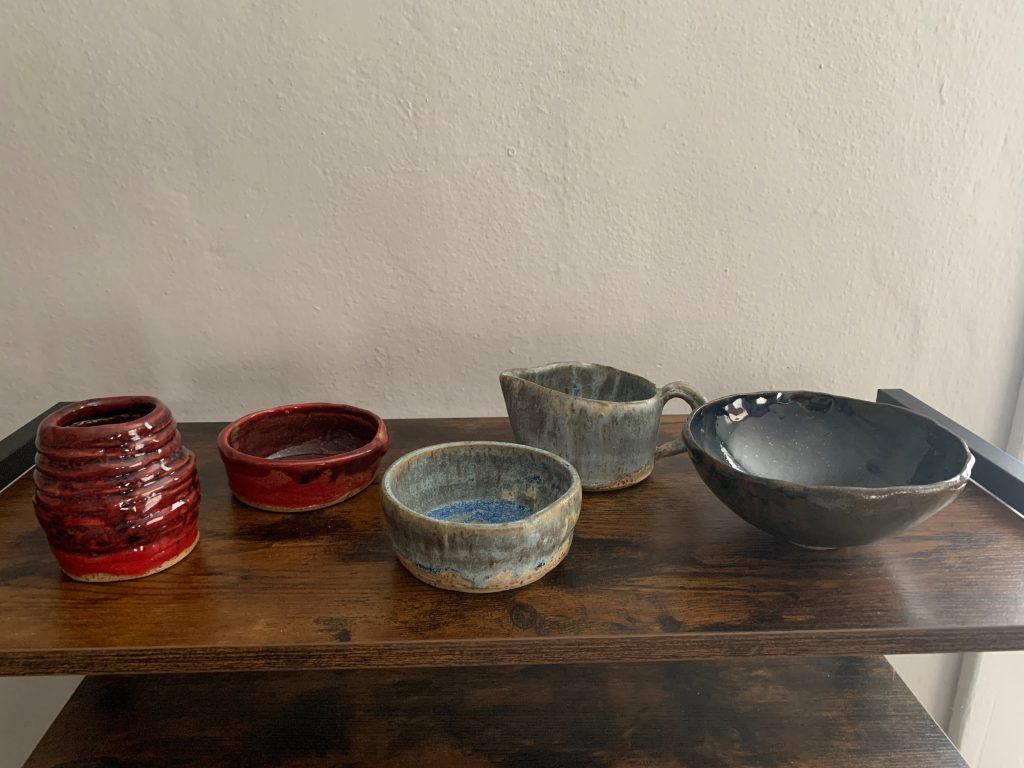
It definitely feels like there has to be some magic involved, especially when dealing with the glazes, since the glaze colors look nothing like the result after the glazed pieces have been fired. There’s a chemical reaction, and glazes drip in the kiln and merge with other glazes. The red pieces looked pink before they were fired. The dark blue came out almost black. The light blue turned more grayish. We had sample tiles showing what they’d look like, but there were still some differences.