Archive for March, 2026

writing

Plotting and Structure

I’ve been developing a story idea, with a goal of starting to write after Easter. I don’t know if that will happen. I’ve got the main characters figured out and a good sense of the world, but I seem to be lacking a plot. I have a general sense of the main character’s inner growth arc and a big-picture goal, but I have no idea how to get there. I was feeling like I had a lot of the book figured out, but when I wrote down the scenes I knew, it was basically the first act before the story really gets going. The rest is a blank.

This is not a new problem for me. I don’t know how many first chapters I wrote before I actually managed to finish a book, but it took me more than ten years of playing at writing. I was great at coming up with situations and characters, but once I got the characters into those situations, I didn’t know where to go from there. There was a huge empty space between the character getting a mission or assignment and them succeeding in triumph.

I did manage to finish a few books before I started really learning how to plot, mostly because I was writing category romance, so there was a strictly defined structure built-in. It was all about the characters and situation. The conflict was built into the characters and situation, and you just had to go back and forth between attraction and conflict until they overcame the conflict. There wasn’t a lot of external plot.

I finally had an Aha! moment when I saw a workshop on the Hero’s Journey, and it started to make some kind of sense. Just knowing those major turning points helped me considerably. I was able to write Enchanted, Inc. based on that structure.

Since then, I’ve been kind of obsessed with learning about structure and figuring out the ways to put a plot together, but it can still be something of a challenge. Some books fall together easily. Some take a lot more work. Usually, the less focused I am to begin with, the harder it is to figure out a plot. I used to just work out the beginning (the part I usually know best) and have a vague outline and figure the rest would come to me as I started writing, but I’ve learned the hard way that it doesn’t work well for me when I try that. That’s when I have to do major rewrites of the sort where I scrap half the book and start over, or when I write the whole book, am never entirely happy with it, and my agent tells me it’s not something she thinks she can sell. I was the worst of both worlds between a “plotter” and a “pantser,” in that I couldn’t start writing without an outline, but the outline was so vague I didn’t have a lot of structure and got very lost, so I had to write the book to figure out what it was about, and then I had to rewrite it.

I’ve learned that the more detailed an outline I have and the more structure there is to that outline, the better the book ends up being for me. I can write it faster with less frustration and procrastination and I don’t have to do major revisions. I may still need to make changes, often adding or removing scenes, but the structure still mostly holds together. I do all that figuring out what the book is about and scrapping it and restructuring that in the outline rather than in the actual book.

That’s why I’m forcing myself to really think through this book and work out what the plot needs to be before I let myself start writing (well, I have written the first scene, but just because it came to me and I wanted to grab it before I forgot it). The more specific I get up front, the better the book ends up being. I still get ideas as I write and I can go with the flow, but I need that structural framework to begin with or it ends up being just a mess. So, that will be next week’s fun, in between choir rehearsals and services. If I have a good outline by the Monday after Easter, I’ll start writing. If not, then I’ll keep working on plotting.
writing life

Autobiography and Authors

One of the writing discussions I had with the guys who cut down my tree was about the role of the author in any written work. One of the guys asserted that all writing was ultimately autobiography because it was filtered through the author’s perspective. He seemed surprised that I didn’t disagree.

When someone wants to criticize an author, the term “Mary Sue” or “self insert” gets thrown around (particularly toward women). While it can be annoying to read something where it’s painfully obvious that the main character is a stand-in for the author, living out their fantasies and utterly insulated from all story logic, the truth is that just about all characters have some element of the author in them, since we’re the only person we have experience being from the inside out. Our frame of reference is the way we see the world and how we experience feelings, both physical and emotional. We can empathize and sympathize with others and try to put ourselves in their shoes, but we still have to imagine based on our own experiences.

The way I like to describe it is that I put myself in a blender, add some other things, and then a character is what comes out. Each character may draw on different aspects of myself and leave out aspects of myself and will add other things to it, but I’m still in there. I try not to identify so closely with any character that I let the universe warp around that person and create my own little fantasy bubble universe in which a character is the most special snowflake ever and gets all the good things that I’d like to have, but I can’t imagine how I could leave myself entirely out of a character if that character is going to have any dimension.

But, as I said to the tree guys, the key to writing more interesting, varied characters is to make yourself a more interesting person. The more input you have, the more material you have to go into that blender to mix up with aspects of yourself. That means learning and experiencing. When I’m researching a character, I look for memoirs and autobiographies of people who’ve been in similar situations so I can learn about those situations from their perspective. It’ll still be filtered through me, but there’s other input, and adding that information to my head changes me a little because my view is broadened. I read a lot of biography and history, even when I’m not researching a specific book. I like to wander through the non-fiction section of the library and grab random books that catch my eye. I love YouTube because it’s full of people giving their perspectives on random things. It’s all more stuff to go into that blender.

You can talk to people who are different from you or have unusual professions (like the tree guys), go to different places, try doing new things (like taking a pottery class). To be a good writer, you have to be a lifelong learner. That’s a big part of the appeal for me. I like learning and absorbing information, going to new places and meeting new people — and then getting to consider it “work.”

Life

A Year of a House

Today is my one-year anniversary of finding my house, so I’ve now seen it through a full year.

It was actually a year ago last night that I first saw the listing, and I dismissed it. It just didn’t look viable — a 4-bedroom house in a bit more than 1,100 square feet (plus half basement). From the pictures in the listing, I couldn’t figure out how I’d arrange my furniture in the living room, and I didn’t need four bedrooms. But then my brain had other ideas, and I got no sleep that night as my brain arranged things. One of the bedrooms had sliding doors opening onto a deck. Why not use that as the living room? It’s a bit weird to have the kitchen and dining room downstairs and the living room up with the bedrooms, but why not? (It turns out that’s how the house was set up — there’s not even a door on the “bedroom” used as a living room) Then the downstairs could be the dining room and sort of a reception area. The house was old but the kitchen was new, and I really liked the deck.

The next morning, a year ago today, my Realtor contacted me while I was in the process of contacting her, and we set up the viewing later that morning. It was one of those “throw on clothes and run” situations, but the house was only a few blocks from where I was living. I’d never even looked at this part of town, mostly because there weren’t any listings. I didn’t know this street existed. The location was good, in walking distance of downtown and the parks but not on the main street. I loved the wooded back yard. And the moment I stepped into the house, I had the weird feeling that this was mine. It was an odd layout. The rooms were tiny, but I thought I could make it work. I had a vivid mental image of sitting on a couch in that living room, drinking tea and watching it rain or snow on the back yard (I got to do a lot of that this winter).

I wrestled with the decision for the rest of the day. It wasn’t at all what I’d envisioned as my house, so I was having to readjust my ideas and sit with the change, but the next day I told my Realtor I wanted to make an offer. It was accepted the next day. Now I almost can’t imagine living anywhere else. It’s like it was meant to be.

They’d had to do some re-grading of the lot and had put down grass seed under straw, and they’d mowed what was apparently a wild yard, so I didn’t get a good sense of what it was like at this time of year. This year I’m seeing that the yard is full of bulbs of some kind. The daffodils have started blooming, but I don’t know what else is out there yet. This was a particularly cold winter, with the cold weather lingering longer (we had snow last week and a few flurries Tuesday of this week), so spring may be delayed somewhat this year. It’ll be nice to be a lot less hectic in late March and April this year, since last year was a whirlwind. I had the house inspection the week after I first saw the house, then closed on the house in early April and started moving stuff over before the furniture got moved in late April and I cleared out the apartment during the rest of that month. I actually started packing right after I got off the phone with the Realtor when she told me I got the house. I figured I was going to be moving sooner or later, so I might as well box up books.

Now I’m settled. I’m still making adjustments as I get used to being in the house and figure out what I need, but it’s getting there. Next up will be trying to get ahead of the yard as spring sets in and the plants wake up. I let the yard get pretty wild last summer, but now I can identify the weeds I want to get rid of before they get big, and I’m going to add some plants.

I’m looking forward to a whole year without moving. It was around this time two years ago that I started making firm plans to move here. I found out about the apartment in late March and was here in May, so that was a blur. It’s nice to be settled.

writing

Back to the Book

This week I’ve gone back to my draft of Pottery & Peril (tentative title, but I suspect it will stick), book 5 of the Tales of Rydding Village, to review it and develop a revision plan. It’s been about a month and a half since I finished the first draft, so it’s ready to look at again. I went through scene by scene to analyze what was happening and what needed to be added or deleted and to spot patterns. I made a plan for revisions, and now I’ll make the major revisions (anything that affects the plot or character arcs) and let it rest again before I start tinkering with the words. I like to let it rest between drafts so it’s less familiar and I’m coming to it more as a reader would, without all the knowledge that was in my head as I wrote it.

I don’t think the revisions will be too extensive. I mostly need to play up the emotional arcs and make some character motivations clearer, but the plot seems to hold together pretty well. Doing an extensive outline and really making myself think through the specifics before I start writing is paying off in that it allows me to write the first draft more quickly and easily and I don’t need to take the whole book apart when I’m revising.

I’m currently in the outlining stage for another book, so I needed this reminder. Whenever I try to tell myself that I have a good idea of where it’s going and I can figure the rest out as I get there, I remember that it never works well when I do that. It’s a lot easier to revise an outline that isn’t working than to do multiple versions of the same book, trying to get it to work. I’m impatient to start writing (and I even wrote the opening scene last week), but the book is nowhere near ready to be written. Maybe by the end of the revisions on this other book this one will be ready. I’ve been working on revisions in the morning and brainstorming in the afternoon and evening.

I got my pieces from the pottery class I took to research Pottery & Peril, and they look rather like a kindergartener’s art project. Pottery is definitely something that takes a lot of practice to get good at, and while I enjoyed it, I’m not sure I enjoyed it enough to want to put in that kind of time (and expense) in order to master it. I did learn a lot that will be going into the book during this round of revisions, little details about how the clay feels, how rough your hands get after working with clay, and how long it takes to do things. I had to adjust the book’s timeline so that a character could start making a piece during the book and have it finished before the end, since it turns out that pottery has to dry completely before it can be fired, and that can take weeks. I’m cutting it close, as it is.

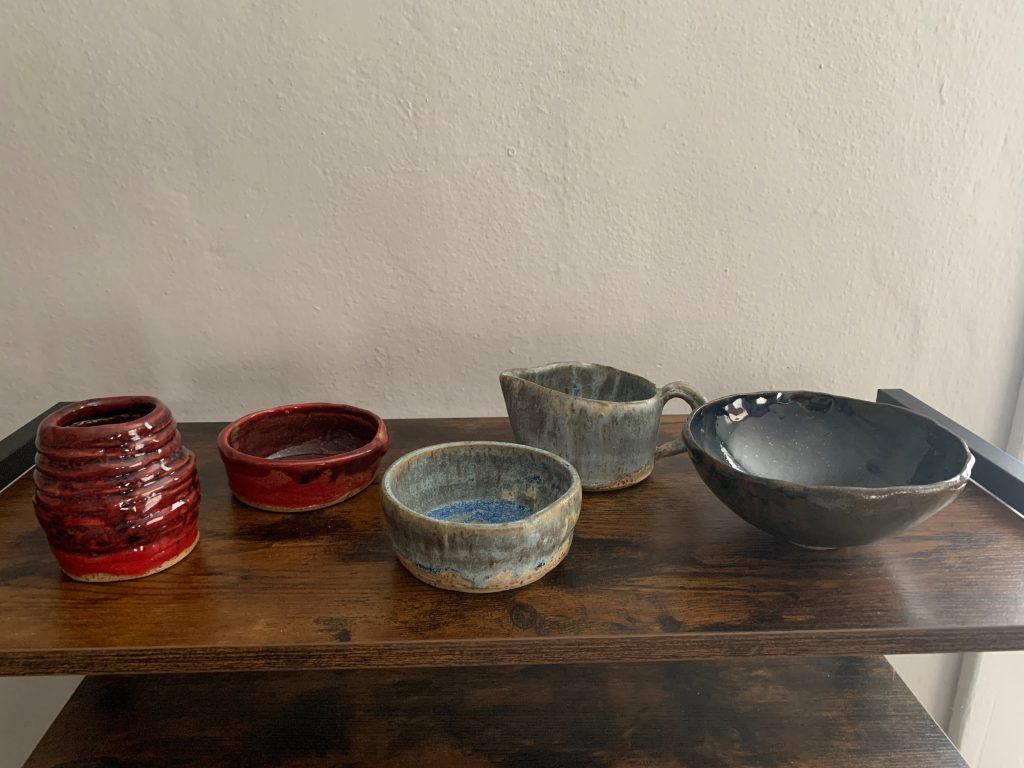
A row of chunky pottery.
From the left: A vase made using the coil method, two bowls made on the pottery wheel, a pitcher made on the wheel (it was supposed to be a vase but it went wonky and the teacher suggested I go with that and make it a pitcher), and a molded bowl.

It definitely feels like there has to be some magic involved, especially when dealing with the glazes, since the glaze colors look nothing like the result after the glazed pieces have been fired. There’s a chemical reaction, and glazes drip in the kiln and merge with other glazes. The red pieces looked pink before they were fired. The dark blue came out almost black. The light blue turned more grayish. We had sample tiles showing what they’d look like, but there were still some differences.

TV

Costume Dramas

I’ve found a couple of things on TV recently that I’ve enjoyed. I seem to be on a costume drama kick because I can’t seem to get into contemporary-set shows and movies, but put historical costumes on the characters and I’m interested.

First, there’s The Artful Dodger, which is a Hulu show, but it’s currently also available on Disney+. This is sort of a sequel to Oliver Twist, following the Artful Dodger (now going by his given name, Jack) years later. He got caught as a thief and was sentenced to be transported to Australia. On the voyage, he began helping the ship’s surgeon, got trained as a surgeon, and ended up joining the Royal Navy as a surgeon. Now he’s in his late 20s and has left the navy to be a surgeon at a hospital in Australia — and then Fagin shows up and tries to pull him back into a life of crime. It’s tempting because the surgeons aren’t on a salary. The patients pay them directly, and the higher-class surgeons get all the paying patients, leaving him with the charity cases, so he needs money, but he has to admit that he also kind of enjoys the thrill of a good scheme. And if he doesn’t get involved and help Fagin, there’s a good chance Fagin will screw it up and get him implicated anyway. Things get even more complicated when the governor’s daughter catches them in one of their schemes. She’ll stay silent if Jack will help her train to be a surgeon. She’s read all the books and keeps up on the latest medical journals, but has no practical experience. Between the two of them, with his practical experience and her book knowledge, they make the perfect surgeon — if only he can stay out of prison.

This is mostly a lighthearted caper show, though I sometimes find it hard to watch because it’s what I call Bad Decisions Theatre. Most of the trouble the characters get into is because they make really bad decisions, and I have to remind myself that the decisions make sense for the characters, even if they aren’t the choices I’d make. There’s still some, “Oh, no, don’t do that!” shouted at the screen. There’s a growing romance (that includes some bad decisions). They have a lot of fun with the Dickens source material, bringing in some characters from other books, and then their view of what Oliver Twist would turn out to be like as an adult is hilarious (and makes a lot of sense).

Jack/the Dodger is played by Thomas Brodie-Sangster, perhaps best known as the little boy with a crush on his classmate in Love Actually, but also the oldest kid in the first Nanny McPhee movie, along with appearances on Doctor Who, A Game of Thrones, and a cameo in The Force Awakens (hitting a geek trifecta), plus he was the voice of Ferb on Phineas and Ferb (must have been an easy gig because the running joke was that Ferb spoke once per episode). Now he’s all grown up, but he still somehow looks exactly the same as he did as a kid while still looking mature. He doesn’t have a baby face. I think it was that he came across as an old soul as a kid, so his features just solidified instead of changing. It took a little time in this show to get used to the idea of him being an adult and doing adult things (which wasn’t helped by the fact that I watched the show in January and February after watching Love Actually on Christmas Eve).

Then there’s the new production of The Count of Monte Cristo. I believe it will start airing on PBS in the US on March 22, but the whole series is already streaming on Passport if you donate to your PBS station. I think I was in high school when I read the book (when I went through a Dumas phase that had nothing to do with any required reading in school), so the details are blurry enough that I don’t know how faithful this adaptation is, but it feels faithful, at least more so than a lot of movie adaptations tend to be. The story is about a young man who’s wrongfully imprisoned. While he spends 15 years locked away with no trial, a fellow prisoner educates him and clues him in about the location of a lost treasure. He manages to escape, then uses the treasure to set himself up in the new identity as the Count of Monte Cristo. When he learns about the three men who got him sent to prison to further their own positions, he sets out to get his revenge on them. What I’ve always loved about this story is that he doesn’t get revenge by doing anything to them. He merely reveals things they’ve done (sometimes getting justice for other people they’ve wronged) or sets up traps that they walk into because of their corruption (a good person wouldn’t be caught in these traps). It’s a great story if you find true justice satisfying, though the first episode when our hero is getting wrongfully imprisoned is tough to get through.

I thought this was an excellent adaptation and I watched the whole thing in a week because it was like a book I couldn’t put down. Sam Claflin plays “Monte Cristo,” and I was surprised to see that he’s become something of a rom-com leading man in recent years because I mostly remember him as the guy in the thankless roles in fantasy-type movies. He was the young missionary held captive by the pirates in the fourth Pirates of the Caribbean movie, and he was the duke’s son who’d been Snow White’s childhood friend in Snow White and the Huntsman. He was supposed to be the Mr. Wrong in the love triangle with the Huntsman, but I thought he was a far more interesting character. I think he does a good job here as a guy who had most human feeling burnt out of him and who’s fixating on the wrong thing for what will fix him. He’s simultaneously a good guy and a bit of a soulless monster, and the fact that he’s being a soulless monster is eating away at the good guy part of him.

If you have Passport, check it out now, and if you don’t, then check it out when it comes on TV. Passport is probably the most reasonable streaming service. It’s a $5/month (or $60/year) donation, and you get so many of the Masterpiece Theatre shows (present and past), plus all the Ken Burns documentaries, tons of Great Performances stuff, etc. There are the usual sponsor promos at the beginning of a show, like when you watch on PBS, but no ad breaks, and you can usually get all the pledge drive programming without the pledge breaks. They also usually drop whole seasons up front so you don’t have to wait for the next episode, and sometimes, like in this case, they drop them before they come on TV. Since I’m not a night owl but live in the Eastern time zone, I like it for time shifting. I may watch the episodes on the same day they air, but I watch them an hour or more earlier. (I’m not being sponsored here, I just genuinely think this is a good deal and a good cause.)

Life

Advanced Forestry

I spent the last two days getting my tree taken down, and it was fascinating to watch. One of the guys climbed the tree (I think he had some kind of spikes on his boots to help, but otherwise he was free climbing) to place the anchor lines that they then clipped to and used to go up and down. He’d swing over to a branch, tie a line around it, cut it off, and the guys on the ground would use the line to lower it. It was like watching Cirque du Soleil with chainsaws.

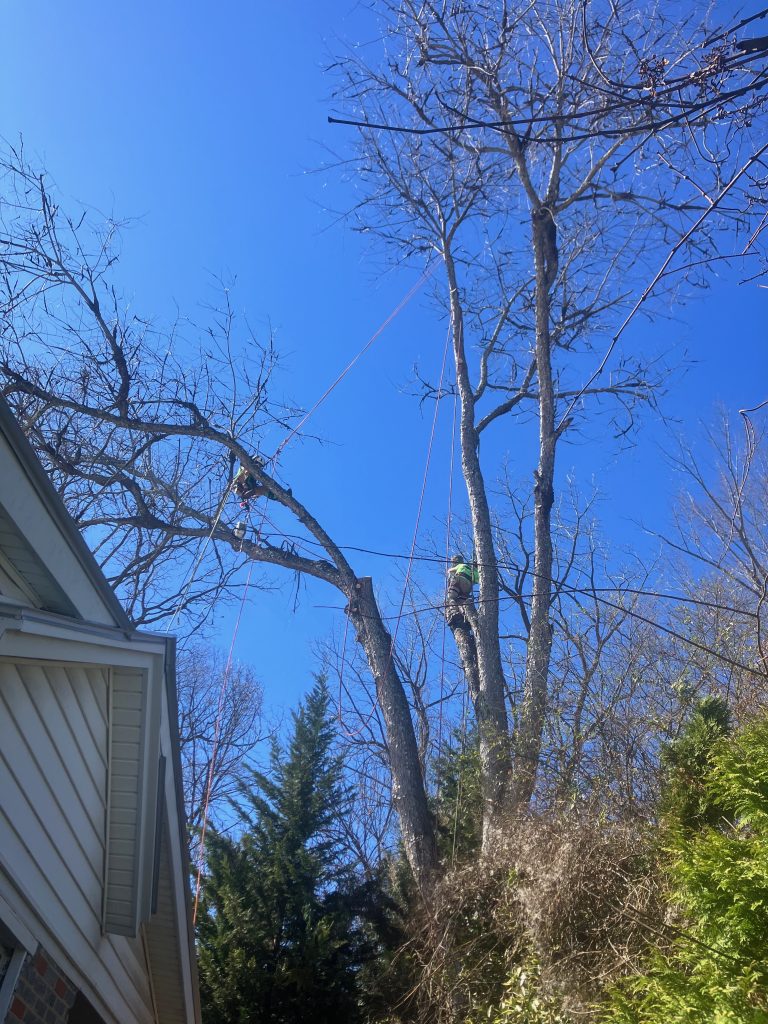
A view of a very tall tree. There are small dots up in the branches that are men working on the tree.
If you look carefully, you can see the two guys working up in the tree. That gives some scale about just how tall that tree was.

The got most of the work done on Monday and just had to wrap it up on Tuesday, but that was when they were dealing with the trunk of the tree, and with a tree that old, you can imagine the trunk was pretty thick. When it got closer to the ground one of the guys asked if I wanted the trunk cut down or if I wanted him to make me a chair, so after a bit of chainsaw carving I have a tree stump throne for surveying my kingdom. I’m pretty sure I’m going to use that in a fantasy novel.

A chair carved out of the stump of a large cherry tree.
My new throne for surveying my woodland realm. I probably need to give it a good sanding.

I’d also asked for another tree to be trimmed around power lines as part of the contract, but they went ahead and trimmed all my trees, cutting off any bad branches they noticed, and they left me a nice stack of the cherry wood to use for the fire pit, in a smoker, or for carving. The guy who carved my chair is planning to make a table out of some of the wood, so the tree will live on in some way.

It turned out that a couple of the guys were aspiring authors, so we talked shop and I gave them advice (I think the chair carving was “payment” for the writing advice). They were really cool and interesting to talk to, but it’s so nice to have my house and yard to myself again and to have some peace and quiet after two days of chainsaws going constantly. I was utterly exhausted by the time they left yesterday, and I wasn’t even the one doing any of the work. I think it was just the release of constant low-level tension. It was lovely this morning to have breakfast in my pajamas instead of being up, dressed, and ready for the tree crew to come first thing in the morning.

I’m eager to start doing some landscaping, but we still have a chance of freezing nights, so it’s a little early to put plants out. I have crocuses coming up in my backyard, though, and daffodils are about to bloom. I didn’t see this house until late March last year, and they’d mowed everything down to show the house, so the spring flowers are going to be a surprise this year.

A small cluster of white crocus flowers sits among dead leaves and twigs.
Some of my backyard crocuses.
Life

Weather Whiplash

Texans like to talk about how much their weather changes, but in some times of the year, I think Virginia can be even worse. Last weekend was warm and sunny. I spent most of the weekend working in the yard, trying to dig up some weeds that produce barbed seeds before they can sprout the branches that produce these seeds. I walked to church, and I spent time sitting out on my deck. Even so, there were still piles of ice/snow left from the late January storm. I had to step around these on street corners as I walked downtown.

Monday, I spent the day snuggled on the sofa with the electric blanket, watching it snow. It was above freezing most of the day, so the snow didn’t really stick, but the evergreen trees in my yard looked like flocked Christmas trees.

We had a couple of cool, rainy days, then it got warm again. I spent most of yesterday sitting on the deck, brainstorming a book. It’s supposed to stay warm for most of the next week. Maybe the last of that ice will finally melt. I’m hoping to get more work done in the yard. It looks like I’m going to have a lot of bulbs flowering soon, so I want to get the bad plants out of the way.

I’m having to take down one of my trees, the biggest one. It’s blighted, so it’s dying/dead and will become a hazard soon. The tree guy estimates it’s about 100 years old, so it pre-dates my house. It’s actually closer to my neighbor’s house and part of it hangs over their roof, so I want to get it taken care of before it starts dropping branches. My house is probably safe from it, unless it topples over entirely heading downhill. The tree guy has suggested other trees I could plant and where I should plant them. That may have to wait because having a 100+ foot tall tree taken down from a spot where they can’t reach it with heavy machinery is rather expensive (though less expensive than replacing my neighbor’s metal roof and solar panels). They’re coming next week to do the work, and they do it by climbing the tree and cutting it down from the top. I may spend those days on the deck, watching the progress.

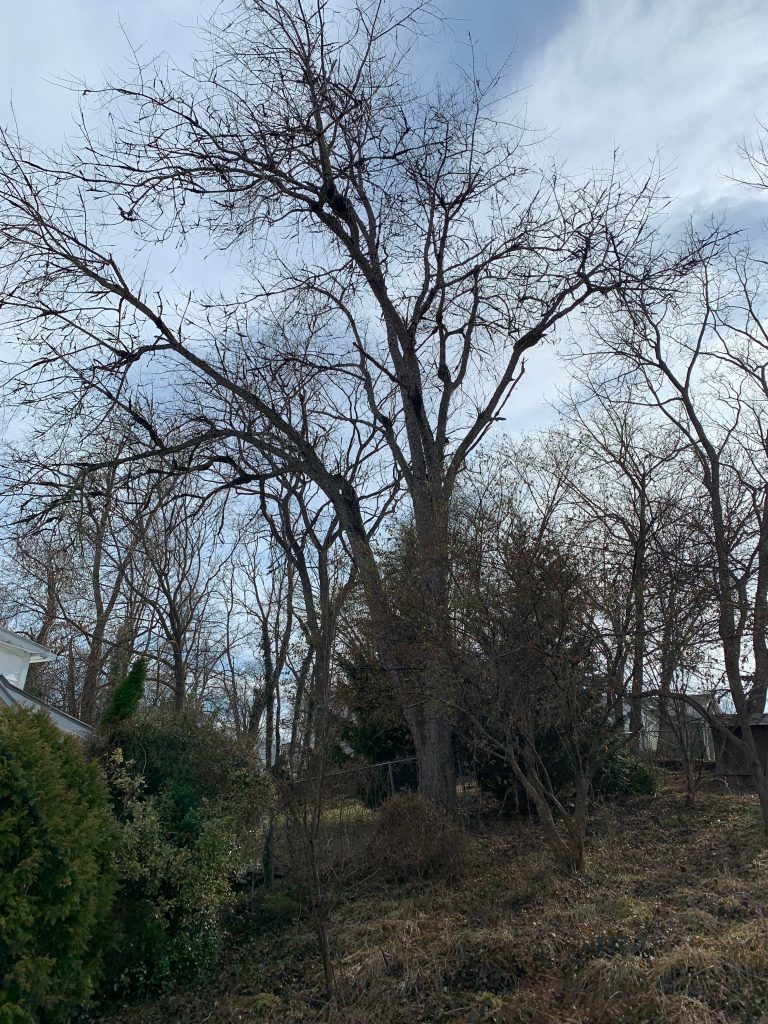
A tall, bare tree with lumpy blighted branches looms over the yard and the house next door.
My poor blighted tree. For scale, you can see the roof of my neighbor’s porch to the left.
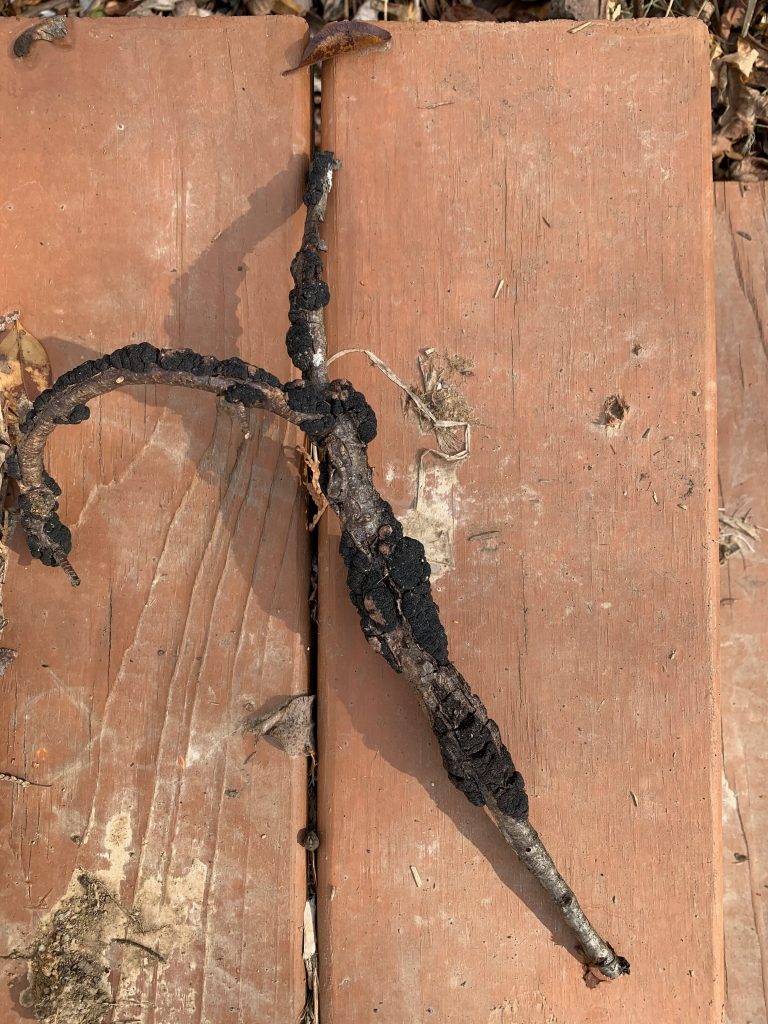
A twig is covered with a disgusting black growth.
And this is why the tree has to come down. The branches are covered in this blight. That’s the bumpy stuff you can see in the tree’s branches.

I’m hoping we’re done with snow and ice, but they tell me it can come as late as April. At least we should be done with single-digit temperatures for the season. Everyone tells me this was an unusually brutal winter. In Texas, I usually dreaded spring because it meant summer was coming, and that was miserable, but now I’m enjoying spring weather and watching things come back to life. Except for the weeds.

writing

The Process: Characters

One thing I tend to get praised for in my books is my characters. I seem to write characters that readers fall in love with and like spending time with. I have to admit that I like my own characters. I could spend time with most of them without them having to do anything (in fact, there are a lot of scenes that end up getting cut because they aren’t needed for the plot and are just the characters hanging out). I don’t have one particular process for creating characters, but there are a number of things I may do.

Sometimes a story idea starts with a character and I try to find a story to fit them into. Sophie in the Fairy Tale series was one of these. She’d been living in my head for a long time before I figured out where to put her. But most often, I come up with a story concept first and then figure out what characters I need to tell that story. Usually there’s a character who comes up first, who may or may not be the main character, and then the other characters build outward from there. In the book I’m currently developing, I knew something about who the main character would be, but they were pretty vague still. It was another character who came to life first, and then from there I was able to flesh out the main character, and as I developed the setting and the story more, other characters started coming into focus.

There are a few tools I use to find the characters. I’m fond of the Enneagram, which sorts people into personality types. Generally I can read through these and one will jump out as a good fit for a character, and then as I go through the descriptions, the character will start to come to life in my head. At that point, I start adding other details and usually don’t refer to the Enneagram again. I may also play with archetypes. At this point, I can do the usual character worksheets to get physical description, goals, needs, key things from the backstory, character traits and quirks, personality, likes and dislikes, etc. I try to throw in at least one thing that’s a bit unexpected so that the character isn’t a stereotype. Just one trait that’s the opposite of what you’d expect for that kind of person really brings a character to life and makes them feel more three-dimensional.

If a character hasn’t solidified during this process, I may “cast” the character, thinking of an actor who might be a good fit. Then I can usually start hearing their voice in my head, and once the character has come to life, I can ditch the casting.

A big thing about creating a character is what the character wants, and that comes in layers.

There’s the story goal, which is usually an external, concrete thing. You could write a movie scene (so no introspection) showing them getting this thing. It’s something that comes up during the story, mostly for the protagonist, but other characters may have their own goals for subplots, or they may support or oppose the protagonist’s goal.

Then there’s the personal goal. This is something the character already wants at the beginning of the story. In musicals and Disney movies, there’s often an “I Want” song at the beginning, and this tells you what the character’s personal goal is. Think “Part of Your World” in The Little Mermaid. She wants to be human at the beginning of the story, before she knows the prince even exists. It’s only later that she gets the story goal of getting the prince to kiss her so she can stay human. There may also/instead be a need, something the character needs in order to be their true self or be happy but that they don’t even know they need. They think the thing they want will make them happy or change their life, but the need is the thing that will really work. The personal goal may either conflict or dovetail with the story goal. The personal goal can be somewhat abstract, so you may not necessarily be able to write a movie scene of them getting it, but it will be clear that they have it.

Then there’s what I call the drive, the need deep down inside that causes the character to make the kinds of decisions they make. It’s a need that can never truly be met because they’ll always either need it or fear losing it. These drives are basic things like the need for love, security, power, control, etc. Yeah, everyone needs these things to some degree, but the drive is the one that powers the character, and it doesn’t change unless the character goes through a transformation so profound that they’re basically a different person.

Once I know these things about a character, I can develop a plot that forces them to change and grow and that will be driven by them making choices that are consistent with their character. But as I plot I may come up with ideas for the characters, so it tends to go back and forth. Characters drive the plot, which alters the characters.

I generally know a character is ready to write when I find myself imagining them in scenes that won’t be part of the plot, just them in normal life before the story begins, doing things like their job or hanging out with friends. I can see how they’d react to various events and what they do when there’s no crisis going on. Then I feel like I really know the character, so it’s time to throw them into the story.